
Reviewed · VIENTIANE TOURS
Vientiane Half-Day City Tour
Vientiane’s greatest pleasure is its calm. This half-day outing gives you a quick look at the capital’s temples, French-era buildings, war legacy, golden monuments, and Mekong riverfront without making you wrestle with taxis or maps. Wat Sisaket and COPE give the tour its strongest sense of place.
I like the choice of morning or afternoon departure, and I like the small-group limit of seven. Guides including Mr. Go, Parn, Lotty, and Xaiixana Mahavong have been praised for clear explanations, kindness, and extra help. One thing to consider is the uneven timing: some outings have lasted about three and a half hours, while another finished in a little over two.
- Wat Sisaket’s thousands of Buddha figures: Begin with Vientiane’s most atmospheric temple, still intact after the 1828 Siamese invasion.
- COPE’s sobering wartime story: Learn how unexploded ordnance continues to affect Laos and how clearance and medical support are being handled.
- Patuxay rooftop views: Climb the monument for a broad look across Vientiane.
- That Luang’s golden spire: Visit Laos’ holiest site and one of its most important national symbols.
- A small group and hotel transport: Travel in an air-conditioned vehicle with no more than seven people booked together.
- A useful first-day orientation: See the main sights in one outing, then return to places you want to explore more slowly.
A gentle first look at Vientiane
Vientiane is not a capital that tries to overwhelm you. Its streets feel quiet compared with many Southeast Asian cities, and its appeal comes from the way Buddhist temples, French colonial traces, modern government buildings, war history, and the Mekong sit close together.
That makes this four-hour tour a sensible introduction. You are not spending a whole day on the road. Instead, you get a guided circuit of the main sights, with hotel pickup and return included. For a first visit, that can save time and help you understand the city’s layout before exploring on your own.
The experience costs $89 per person. That is not a bargain-priced walk, but the price includes an English-speaking guide, an air-conditioned vehicle, a driver, and hotel transport. With a maximum of seven people, you are paying for convenience and personal attention as much as for admission to the sights.
Starting at Wat Sisaket
The tour begins at 9:00 am for the morning departure or 2:00 pm for the afternoon option. Your first stop is Wat Sisaket, also written as Wat Si Saket, a temple with a particularly important place in Vientiane’s story.
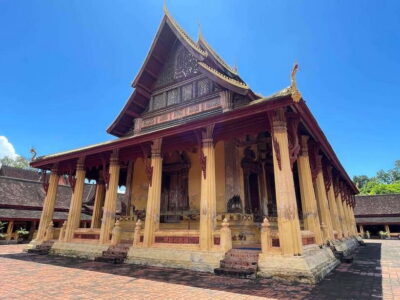
The temple is described as the only one left intact after the Siamese invasion of 1828. Its covered teak hallways and thousands of small Buddha statues give it a peaceful, enclosed feel. This is the kind of place where a guide adds real value, since the details are easy to miss when you are simply walking around a courtyard.
Allow yourself time to look closely at the rows of figures. The setting is calm and shaded, which also makes this a good early stop before the heat of the day builds. If you take the afternoon departure, the temple visit may be more comfortable than a long outdoor walk, though the exact pace depends on the group and the guide.
Wat Sisaket is often the emotional high point for visitors who prefer quiet religious sites to grand monuments. It feels less like a photo stop and more like a place with its own rhythm.
A few more Vientiane trips worth a look
- Vientiane: Half-Day City Tour with Patuxai and Buddha Park
★ 4.5 · 57 reviews - Half-Day Vientiane City Bike Tour | Laos
★ 5.0 · 5 reviews - Vientiane: Half-Day City Tour – Morning or Afternoon
★ 4.0 · 3 reviews
Wat Phra Keo and the French governor’s palace
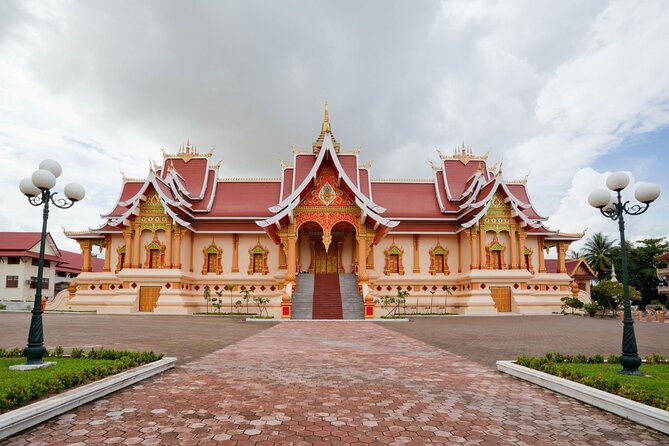
The next stop is nearby Wat Phra Keo, now used as a religious museum. Its displays include Lao and Khmer works of art, giving you a chance to compare artistic traditions within the region.
The word museum matters here. This is not simply another active temple visit, so expect a collection of religious objects and artwork rather than the same kind of experience as Wat Sisaket. Your guide can help explain what you are seeing and place the pieces within Laos’ cultural setting.
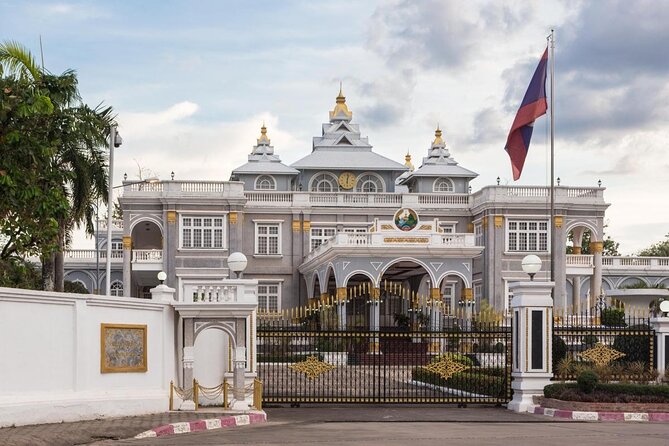
The Presidential Palace is also close by. You cannot go inside, but the exterior offers a glimpse of Vientiane’s colonial past. The building formerly served as the French governor’s palace, so it helps show how the city’s political identity changed over time.
This stop is brief but useful. You get a visual reminder that Vientiane’s story is not only about temples and kings. French administration also shaped the capital’s architecture and civic center.
COPE and the lasting cost of war
COPE, an association that helps landmine victims, gives the tour its most serious stop. The center explains the history of the American and Vietnam War period and the continuing effect of unexploded ordnance in Laos.
This part can change how you see the rest of the country. Unexploded bombs are not only a subject from the past. The center describes the work still needed to clear dangerous material and support people affected by it. You will also learn about efforts to provide help for landmine victims.
I value the inclusion of COPE because it keeps the tour from becoming a string of attractive monuments. Vientiane’s identity includes beautiful temples, but it also includes difficult political and human stories. A good guide can make this stop especially useful by answering questions and linking the information to what you will see elsewhere in Laos.
Plan for a more reflective visit here. It is not a light sightseeing stop, and that is precisely why it belongs on a serious city tour. If you want only architecture and scenic views, COPE may feel heavy. If you want a fuller understanding of Laos, it is one of the most worthwhile parts of the route.
Climbing Patuxay for a city view
Patuxay is often described as Laos’ version of the Arc de Triomphe. The comparison helps you recognize its monumental form, but the structure belongs to Vientiane and carries its own national meaning.
You can climb the stairs to the roof for panoramic views of the city. This is the tour’s clearest chance to look across Vientiane from above. The view also helps you make sense of the capital after seeing its central temples and government buildings at street level.
The climb is an active part of the outing, so wear comfortable shoes and take your time. The tour information says most people can participate, but anyone who dislikes stairs should keep this stop in mind when deciding if the outing suits them.
Patuxay works well after the museums and temples because it gives you a wider frame. Instead of seeing one building at a time, you get a sense of the city’s relatively open scale and quiet character.
Same country, a completely different kind of day:
- Vientiane Cultural Tour with Private Guide
★ 5.0 · 80 reviews - Vientiane: Cultural Tour with Buddha Park and Patuxay
★ 4.6 · 74 reviews - Vientiane Cuisine & Culture: The Hungry Tuk Tuk
★ 4.5 · 53 reviews - Vientiane City Highlights Tour with Buddha Park & Lunch
★ 4.7 · 38 reviews
That Luang and the golden spire
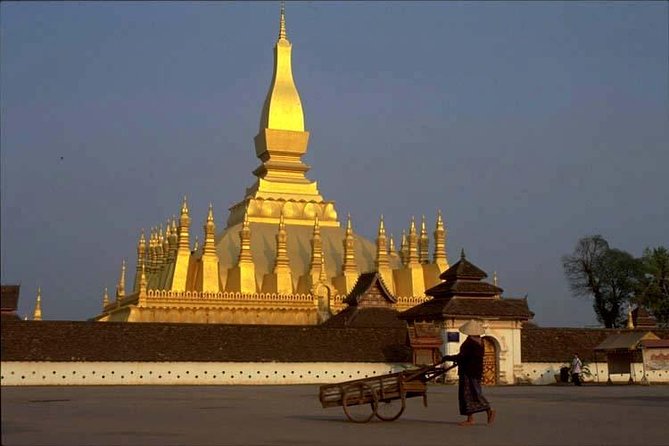
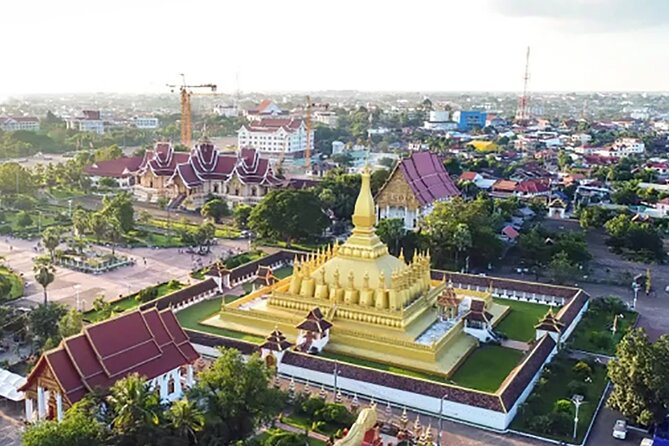
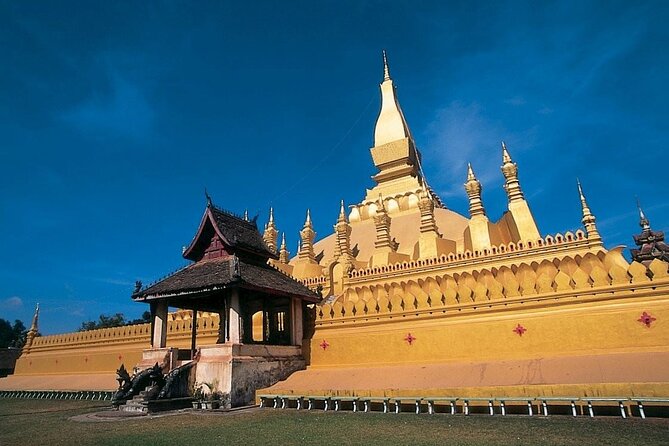
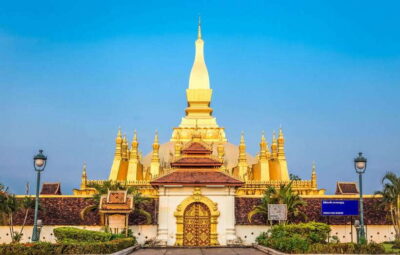
The route continues to That Luang, the holiest site in Laos. King Setthethirat constructed it in the 16th century, and its tall golden spire catches the sun in a way that makes the monument hard to ignore.
That Luang is more than a grand religious building. It is an important national symbol, so the stop gives you a better feel for the place of Buddhism and monarchy in Lao identity. Your guide can explain the site in a way that a quick photograph cannot.
The golden surface may be the first thing you notice, but do not rush past the surrounding details. Take a moment to absorb the scale and the contrast between That Luang’s formal presence and Vientiane’s generally unhurried mood.
Timing can affect the feel of this stop. The morning tour begins early enough to reach the site before the hottest part of the day. The afternoon tour gives you a later schedule, but sunlight and heat may be different. The available details do not specify how long the group spends at each attraction, so ask your guide if you want extra time at That Luang.
Finishing beside the Mekong
The final stop takes you to the Mekong River. You can stroll along the bank, stop for a cold drink, or try a snack from one of the local food stalls.
This ending is well chosen. After several historic and religious sites, the river gives you a more everyday view of Vientiane. It is a chance to slow down, watch local life, and decide which part of the city you want to revisit later.
Food and drinks are not included, so bring some local currency if you want to buy something. The stop is flexible in spirit, but the exact time available will depend on the tour’s pace. Since the entire outing is advertised at about four hours, do not expect a long riverside meal.
After the Mekong stop, you are driven back to your hotel. That return is especially useful in the afternoon, when you may prefer not to arrange transport after several sightseeing stops.
The guides make the difference
The quality of this tour depends heavily on the guide assigned to your group. Strong guides have included Mr. Go, Parn, Lotty, and Xaiixana Mahavong. Their strengths have included clear English, good explanations, cultural insight, friendliness, and practical help during the day.
Mr. Go has been praised for making the route fun and easy, while Parn has been described as friendly, accommodating, and careful in explaining the sights. Lotty is noted for answering many questions and caring about the overall experience. Xaiixana Mahavong has been singled out for strong knowledge of the locations and the history.
There is one important qualification. One outing had a guide who was kind and helpful but had limited English, which made the explanations less useful. That is a reminder that a small group does not automatically guarantee a strong commentary. The guide assignment matters.
You can improve your chances of getting more from the tour by preparing a few questions about Lao religion, the 1828 invasion, French rule, and unexploded ordnance. The best part of a guided city tour is often the conversation between stops, not just the formal description at each monument.
Timing, transport, and group size
Hotel pickup is offered for both departures, with collection at 9:00 am or 2:00 pm. You should provide a contact phone number when booking, since that is part of the required information.
Transport is in an air-conditioned vehicle, with a driver and professional English-speaking guide. A maximum of seven people can take part in a booking, and the activity itself also has a maximum of seven participants. That is a useful size for a city tour because you can hear the guide without dealing with a large coach group.
The stated duration is approximately four hours, but allow some flexibility. One outing lasted about three and a half hours, while another was reported as a little more than two hours. Delays, the pace of the group, time at each site, and the guide’s approach can all affect the final length.
Most people can participate, and the tour is near public transportation. The minimum age is 12. Patuxay involves stairs, so the rooftop view may not suit everyone even though the general activity is considered suitable for most people.
Is $89 a fair price?
At $89 per person, this tour makes the most sense when you value an efficient introduction and private transport over the lowest possible cost. You are visiting six distinct parts of Vientiane, including Wat Sisaket, Wat Phra Keo, the Presidential Palace, COPE, Patuxay, That Luang, and the Mekong area.
The guide is the key part of the value. If you receive someone with strong English and a good grasp of Lao culture and politics, the temples and monuments become much easier to understand. If the commentary is limited, the price may feel high for a short sightseeing circuit.
The small group helps. You are not paying for a large bus, and the maximum of seven allows you to ask questions and move between stops without a crowd. Hotel pickup and drop-off also matter if you have only a short stay in Vientiane or do not want to arrange transport for each site.
I would compare the price with your schedule, not just with the cost of visiting the monuments independently. If you have one or two days in the capital, the tour gives you a useful overview. If you are staying longer and enjoy researching temples and arranging local transport, you may prefer to visit the sights at your own pace.
Who should book it
I would choose this outing for a first visit to Vientiane, especially if you want the main cultural sights in a single morning or afternoon. It also suits anyone who prefers a guide for complicated subjects such as wartime history and unexploded ordnance.
It is a good fit for couples, families with children aged 12 or older, and small groups who want a private-feeling outing without booking a large private vehicle. The air-conditioned transport is helpful in a warm city, and hotel return keeps the afternoon or evening free.
I would think twice if you want long visits at each attraction. The route covers a lot in a short time, and the inconsistent reports about total duration suggest that the tour can move quickly. It is an orientation tour, not a slow temple study day.
The cancellation terms are straightforward: cancel at least 24 hours before the start time for a full refund. Changes or cancellations inside that window are not accepted for a refund. If the minimum number of participants is not met and the operator cancels, you are offered another date or experience, or a full refund.
Should you book this Vientiane tour?
Book it if you want a practical first look at Vientiane, hotel transport, a small group, and a guide who can connect temples, colonial buildings, national symbols, and the legacy of war. Wat Sisaket, COPE, Patuxay, and That Luang give the route a strong mix of quiet beauty, difficult history, and fine city views.
The main caution is value. At $89, you should expect a strong guide and a well-paced outing, but the actual length and level of English can vary. If you can accept that uncertainty and have limited time, this is a useful way to get your bearings fast. If you have several days and prefer lingering at each site, explore independently and spend the savings on a longer visit to the places that catch your interest.
FAQ
How long does the Vientiane Half-Day City Tour last?
The advertised duration is approximately four hours. The stated departure times are 9:00 am for the morning tour and 2:00 pm for the afternoon tour, though the actual length can vary.
What sights are included?
The route includes Wat Sisaket, Wat Phra Keo, the Presidential Palace exterior, COPE, Patuxay, That Luang, and the Mekong River area.
Is hotel pickup and drop-off included?
Yes. Hotel pickup and drop-off in Vientiane are included.
What type of transport is provided?
Transport is provided in an air-conditioned vehicle with a driver and a professional English-speaking guide.
How many people can join the tour?
The tour has a maximum of seven participants, and each booking can include no more than seven people.
What age must participants be?
The minimum age is 12 years.
Can I cancel for a full refund?
Yes, if you cancel at least 24 hours before the experience start time. Cancellations or changes made less than 24 hours before the start time are not refunded.
Just added around Vientiane
- Vientiane: Lao Cultural Attire Rental Experience★ 5.0 · 3 reviews
- Vientiane: Half-Day City Tour – Morning or Afternoon★ 4.0 · 3 reviews
- Vientiane Private Lao Cooking Class with Market Tour★ 4.0 · 3 reviews
- Vientiane Private Walking Tour With A Guide (Private Tour)★ 4.5 · 3 reviews
- Vientiane: Art, Culture, & Inspiration Guided Day Tour★ 5.0 · 3 reviews
- Vientiane Day Trip By Bike To Tad Moon Waterfall★ 4.5 · 3 reviews
- Half Day Exploring the Charms of Vientiane and hotel pickup★ 4.9 · 4 reviews
- Private Tour Vientiane – VangVieng by Express Train★ 5.0 · 4 reviews
Vientiane Tours, compared.
Vientiane City Highlights Tour with Buddha Park & Lunch
Read our review →
Private Full-Day Tour with Buddha Park and Lunch
Read our review →
Vientiane: Private Full-day Must-See Sights & Sunset Tour
Read our review →Browse the lists this tour appears in