
Reviewed · LUANG PRABANG TOURS
Tribal Cooking Class in Luang Prabang Forest and visit
The most memorable part of this Luang Prabang outing is not the lunch. It is learning how a Khmu guide turns bamboo, stones, plants, and fire into a working kitchen. You walk about 10 minutes to a forest cooking shelter, gather ingredients, shape your own chopsticks and cup, then eat what you helped prepare.
I like the direct, hands-on work and the small private-group format. I also like the connection to village life, especially when guides such as Peng or Pheng explain local farms, plants, and cooking methods. One point needs clearing up: the experience is described as forest cooking, but part of the activity may take place on a farm or in the countryside rather than entirely in primary forest.
Key points to know before booking
- Bamboo becomes your kitchen equipment: You make eating chopsticks and a drinking cup, both of which you can take home.
- A Khmu guide leads the outing: Guides such as Peng or Pheng bring local knowledge of food, farming, villages, and forest cooking.
- The walk is short but active: The forest section takes about 10 minutes, with hands-on work using tools and utensils.
- The food starts with the surroundings: You pick plants and collect ingredients used in the dishes you later cook.
- It is a private five-hour experience: Only your group takes part, with transport from Naga Lodge, lunch, snacks, and bottled water included.
- The setting may vary: Expect a mix of countryside, farm, village, and forest elements rather than a guaranteed full day in untouched woodland.
From Naga Lodge to a Khmu cooking shelter
The meeting point is Naga Lodge Eco Resort in Ban Xieng Mouark, Luang Prabang. Private transportation is included, so you do not need to arrange your own ride to the activity. The outing lasts about five hours, including the drive, ingredient gathering, cooking, and meal.
The route is part of the experience. You are not simply dropped at a kitchen and handed a bowl of ingredients. You move into the countryside and learn how food is found and prepared outside a modern cooking school. The exact stops can vary, but the activity includes time around farms and villages as well as a forest section.
That distinction matters. If you picture a completely wild jungle kitchen from start to finish, adjust your expectations. The experience description centers on primary forest, while the practical outing can include farm-based work. I see that as a useful feature rather than a flaw, since farms show how local food is grown and give you a clearer link between village life and the meal.
The private format is another advantage. You cook only with your own group, rather than sharing a station with a large class. That gives you more room to ask questions, handle the tools, and work at a comfortable pace.
More cooking classes in Luang Prabang:
- Luang Prabang: Evening Cooking Class & Local Baci Ceremony
★ 4.9 · 151 reviews - Luang Prabang: Bamboo Weaving Workshop & Cooking Class
★ 5.0 · 96 reviews - Luang Prabang: Cooking Class at the Former Royal Palace
★ 4.9 · 51 reviews
Gathering plants and learning what belongs in the pot
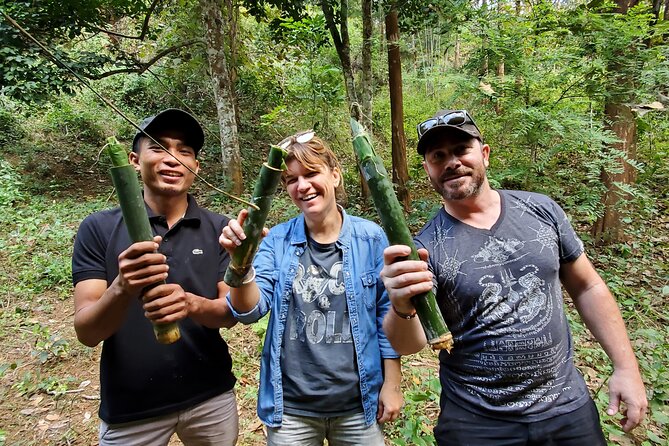
The first lesson is about ingredients. As you walk, the guide points out edible plants and helps you pick the items used for cooking. This turns a standard food class into a lesson about local food sources.
The value here is context. In many cooking classes, ingredients appear already washed and measured. Here, you see at least part of the path from plant or farm to plate. You learn that Lao cooking is tied to what grows nearby, what can be gathered, and what can be prepared with simple materials.
You should listen closely during this section. The activity involves exotic edible plants, and you should only pick what the guide identifies as suitable. The guide’s role is central, since the class depends on local knowledge rather than a printed recipe sheet.
Several guides connected with this experience are named Peng or Pheng in the available information. Peng is described as a farmer with a strong understanding of local farms and villages. That background can make this part especially useful, since farming knowledge explains not only what goes into the meal but also where it comes from.
Do not expect a long hike. The forest walk is around 10 minutes, so this is not a trekking tour. The short distance works well for a cooking day, but it also means the main appeal is participation, not a major wilderness walk.
Bamboo, stone, and fire at the forest platform
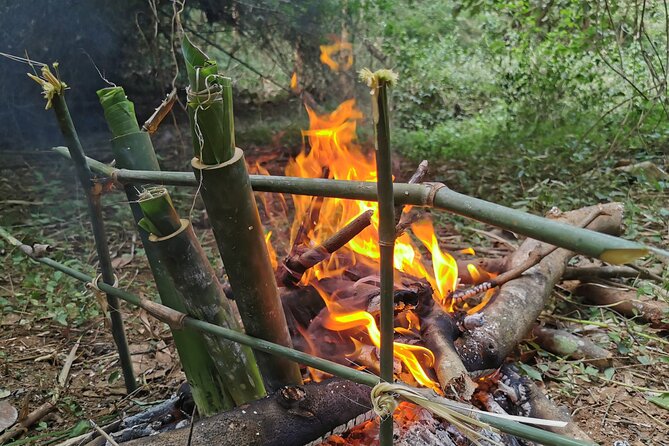
After the walk, you reach a simple shelter or platform where the cooking takes place. The setup is deliberately basic. Bamboo provides the raw material for utensils and parts of the cooking process, while stones and other forest materials help create a workable outdoor kitchen.
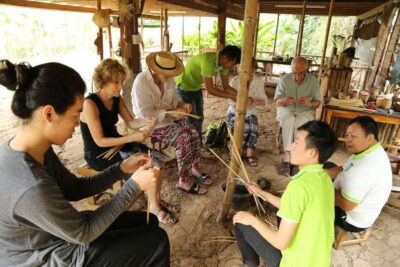
This is the part that gives the experience its character. You are not watching a guide perform every task. You use tools, including machetes, to shape bamboo and prepare materials. One account describes making cover from bamboo at a small platform when rain arrived, which gives you a good idea of the practical nature of the outing. It is not polished or formal, and weather can become part of the day.
Safety and attention matter here. Machetes are useful tools, but they require care, especially when cutting bamboo. The supplied tools and utensils are included, and the guide directs the process. You should wear clothes and shoes suited to an outdoor activity, even though the walk itself is short.
Bamboo is more than a decorative local touch. You learn how it can serve as cooking material, tableware, and a drinking vessel. That helps explain why bamboo is so important in Lao food culture. The material is available, light, and practical, so it fits naturally into a meal prepared away from a built kitchen.
Making your own chopsticks and bamboo cup
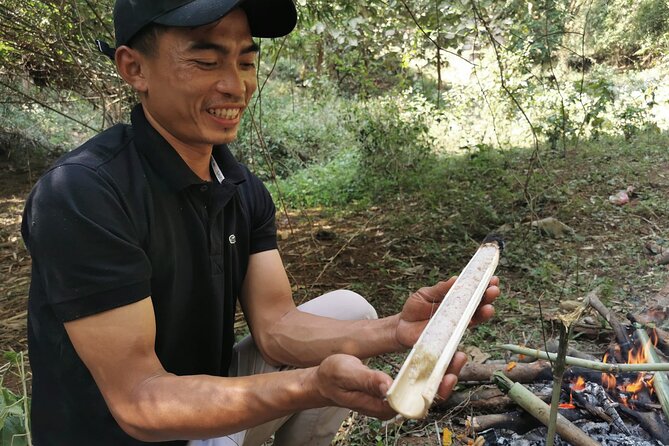
The souvenir is not something bought at a shop. You make your own eating chopsticks and drinking cup from bamboo, then take them home.
I like this detail because it gives the class a lasting reminder without adding a separate craft workshop. You are learning by making something useful. The cup also connects directly to the meal, rather than being an unrelated keepsake.
The work is hands-on and may take patience. Bamboo does not turn into a neat utensil by magic, and the final result may look handmade rather than perfect. That is the point. You get a better sense of the skill involved in preparing everyday objects when you have to shape them yourself.
The activity also includes cooking tools and utensils, so you are not expected to bring equipment. Bottled water, snacks, and lunch are included too. Since the outing lasts about five hours, those inclusions make the price easier to assess.
Same country, a completely different kind of day:
- Luang Prabang: Cruise to Pak Ou Caves & Kuang Si Waterfalls
★ 5.0 · 1,769 reviews - Luang Prabang: Cruise to Pak Ou Caves & Kuang Si Waterfalls
★ 4.8 · 1,360 reviews - Half Day Mekong Cruise to Pak Ou Caves (Morning / Afternoon)
★ 4.6 · 290 reviews - Luang Prabang: UNESCO World Heritage City Highlights Tour
★ 4.6 · 201 reviews
Cooking a Lao meal with what you collected
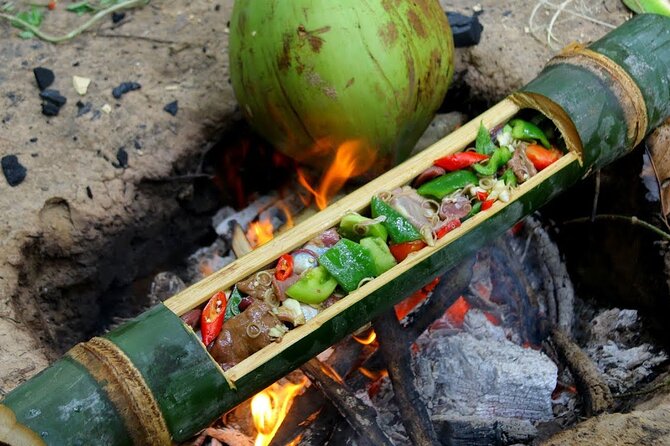
The class then moves from gathering and preparation to cooking. You use the plants and other ingredients collected during the outing to make typical Lao dishes, with the guide showing how the food is prepared using bamboo, stones, and simple fire-based methods.
The supplied information does not provide a fixed menu, so I would not book this expecting a particular dish. The better reason to book is the method: you learn how a meal can come together with local ingredients and limited equipment.
Several accounts describe starting fires, preparing banana leaves, and cooking fresh food. These details suggest that the class may include more than chopping vegetables and stirring a pot. You may handle the basic stages yourself, from preparing materials to cooking and serving.
That is also why the guide matters more than a written recipe. The lesson is built around demonstration and practice. You can ask questions as you work, and the private setup should make it easier to receive direct help.
At the end, lunch is the reward for the work. Eating food you have helped gather and prepare gives the meal more meaning than a restaurant stop. It also makes the activity suitable for people who want a cultural experience connected to daily life, rather than only a scenic outing.
What the countryside and village setting adds
The countryside portions add a useful layer that a strict forest-only description might miss. A farm-based setting shows you where ingredients are grown, and a village visit brings the cooking closer to the people who use these methods in ordinary life.
The experience is linked to the Khmu community through the guide and the cooking traditions being taught. That does not mean you should expect a formal cultural performance. The focus is practical: plants, food, tools, and ways to cook with local materials.
The village setting can also make the day feel more personal. You are not moving between a series of tourist attractions. You are spending time in a place connected to food production and community life. Still, the amount of village interaction is not specified, so you should see it as part of the setting rather than a separate guided village tour.
For me, this blend is one of the strongest reasons to consider the experience. You get forest elements, farm knowledge, village context, and a meal, all within half a day. The tradeoff is that the activity may not match an exact image of isolated jungle cooking.
Is $78.08 a fair price?
At $78.08 per person, this is not the cheapest way to eat in Luang Prabang. You can find a much less expensive Lao meal in town. The value comes from the five-hour private outing and the work built into it.
Your price covers private transportation, bottled water, snacks, lunch, cooking equipment, and the guide-led activity. You also receive bamboo chopsticks and a cup that you make yourself. Add the countryside transfer and the time spent gathering ingredients, and the cost is reasonable for a private experience rather than a simple meal.
The price is easier to justify for two or more people. Solo visitors should check the booking terms carefully, since one solo participant had to pay for two places because a single-person option was not available. That can change the value calculation considerably.
The activity is booked an average of 23 days ahead, so last-minute availability may be limited. Confirmation is normally sent at booking, though reservations made within one day of the start time are confirmed as soon as possible and depend on availability.
Free cancellation is available until 24 hours before the start time. Inside that window, the payment is not refunded, and changes are not accepted. If the minimum number is not reached and the operator cancels, you are offered another date or experience, or a full refund.
Who will enjoy this five-hour outing?
I would choose this for someone who wants to understand food through place and process. It suits curious eaters, couples, families with older children, and anyone who prefers a practical cultural activity to a passive tour.
It is also a strong choice for people who enjoy learning by doing. You cut bamboo, make utensils, gather ingredients, prepare food, and cook outdoors. The day has an element of bushcraft, though the experience is primarily about Lao food and village knowledge.
You may want to skip it if you need a highly polished cooking studio, a guaranteed menu, or a long forest trek. It is also not the right pick if you dislike outdoor work, rough materials, or the possibility of rain affecting the setup.
The private format helps groups with different interests. One person can focus on plants, another on cooking, and another on making bamboo items. Since the activity is not shared with strangers, you have more control over the pace and questions.
My booking advice for Luang Prabang
I would book this if you want a half-day that connects Lao food with farming, forest materials, and Khmu knowledge. The most praised features are consistent: the guides are kind and hardworking, the cooking feels authentic, and the bamboo work makes the day memorable.
Before paying, confirm what setting is planned for your date. Ask whether the route will include the forest, a farm, or both. That simple question will prevent disappointment if your main goal is untouched woodland.
I would also confirm the guide’s name and the solo booking price if you are alone. The guide can make or break this experience, and Peng or Pheng has been associated with particularly strong teaching. With the transport, meal, materials, private format, and five-hour schedule, the price is fair for a hands-on cultural outing, especially when shared by a small group.
FAQ
Where does the cooking experience start?
It starts at Naga Lodge Eco Resort in Ban Xieng Mouark, Luang Prabang, Laos.
Where does the experience end?
The activity ends back at the meeting point at Naga Lodge Eco Resort.
How long does the activity last?
The experience lasts approximately five hours.
Is transportation included?
Yes. Private transportation is included, and pickup is offered.
Is lunch provided?
Yes. Lunch, snacks, and bottled water are included.
How far do you walk into the forest?
The walk to the cooking shelter is about 10 minutes.
What will I make from bamboo?
You will make your own eating chopsticks and a drinking cup from bamboo, and you can take them home.
Is this a private activity?
Yes. Only your group participates in the activity.
Can I cancel for a full refund?
Yes, if you cancel at least 24 hours before the experience start time. Cancellations within 24 hours are not refunded.
More Workshops in Luang Prabang
- Day-time Bamboo weaving & Cooking Classes join-in
★ 5.0 · 38 reviews - Luang Prabang: Hmong Batik Art Workshop
★ 5.0 · 27 reviews - Evening Bamboo weaving & Cooking classes join-in
★ 5.0 · 17 reviews - Traditional Market Tour and Private Laotian Cooking Class with a Local
★ 5.0 · 13 reviews
Just added around Luang Prabang
- Luangprabang: Dinner with Lao Traditional Dance Performance★ 4.0 · 3 reviews
- Private Luang Prabang City Tour★ 5.0 · 3 reviews
- Sunset Cruise in Luang Prabang with Live Performance★ 4.5 · 3 reviews
- Luang Prabang Night-time Explorer★ 3.5 · 3 reviews
- A Relaxing Day at the Kuang Si Falls★ 4.5 · 3 reviews
- Luang Prabang Private Full-Day Tour and Lunch★ 4.7 · 3 reviews
- Luang Prabang: Local Village & Kuang Si Falls Private Tour★ 4.9 · 3 reviews
- Luang Prabang: Mekong River Cooking Class with Hotel Pickup★ 5.0 · 3 reviews
Luang Prabang Tours, compared.
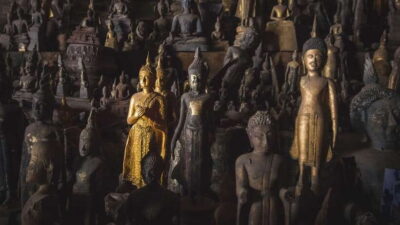
Half Day Mekong Cruise to Pak Ou Caves (Morning / Afternoon)
Read our review →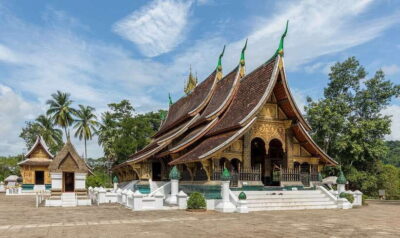
Luang Prabang: UNESCO World Heritage City Highlights Tour
Read our review →
Luang Prabang: Bamboo Weaving Workshop & Cooking Class
Read our review →
Browse the lists this tour appears in